
Quick Answer
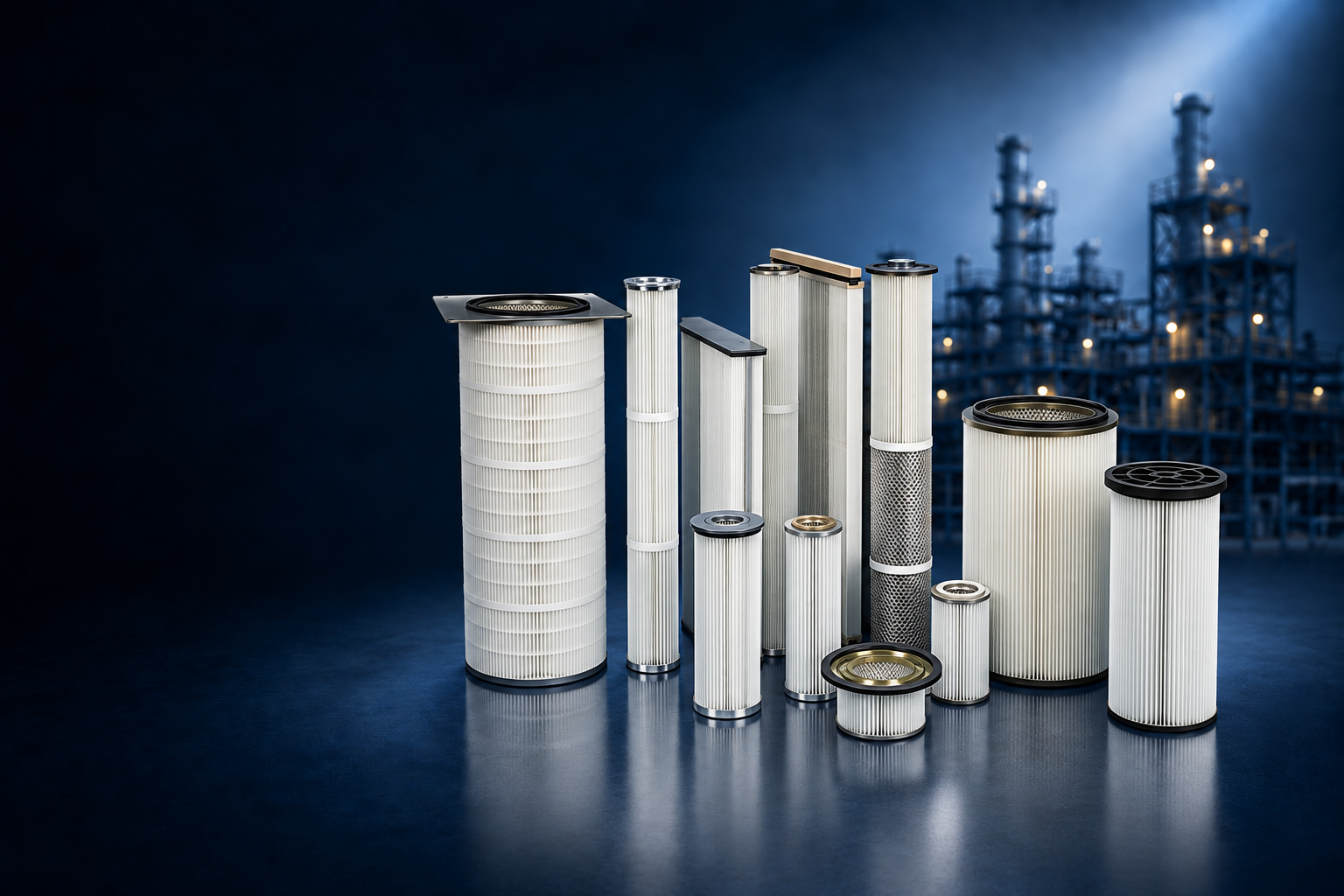
A dust collector cartridge filter is a pleated element that traps particulate in an industrial extraction system. For a replacement, confirm cartridge dimensions and seals, filter media, dust type, collector airflow and pulse-cleaning compatibility. Sutez can be contacted for a cartridge filter enquiry in India.
A cartridge can look like an exact match while its gasket, pleat pack or media behaves differently in service. Dry grinding dust, pigment powders and sticky process residues do not clean the same way. Start with the process and the existing collector model, not a micron figure copied from a catalogue.
Dust Collector Cartridges, Pleated Filter Media, Pulse-Jet Cleaning, Differential Pressure, Air-to-Media Ratio, Dust Extraction
Core Filtration Stages:
Cellulose-Blend Cartridges, Spunbond Polyester, Fine-Fiber / Nanofiber Media, Specialised Filter Treatments
A useful replacement quotation includes cartridge measurements, a photograph of both end caps, the dust source and any symptoms such as rising differential pressure or weak suction.
For a quotation, share the dust collector model, cartridge dimensions, end-cap photographs, dust type, quantity and any issue with pulse cleaning or high differential pressure.
Practical Sutez technical-team guidance (editorial paraphrase, not a verified spoken quote): “Start with the dust and the way the cartridge seals. A familiar size on its own does not tell you how it will clean.”
Table of Contents
- What Is a Dust Collector Cartridge Filter?
- Types of Dust Collector Cartridge Filter Media
- Why Cartridge Filter Selection Matters
- Applications of Cartridge Filters
- Industries Using Dust Collector Cartridges
- Technical Specifications & Buyer Selection Guide
- Maintenance and Replacement Tips
- Discuss Cartridge Filters with Sutez
- Frequently Asked Questions
What Is a Dust Collector Cartridge Filter?
A dust collector cartridge filter is a replaceable, pleated filtration element inside a dust extraction unit. Its job is to retain airborne particulate while the fan draws process air through the filter media. Many systems periodically knock the collected dust cake into a hopper using reverse pulses of compressed air.
A cartridge is not a complete dust collector: the fan, ducting, inlet design, hopper, seals and cleaning controls also affect how much dust is captured.
Which details decide whether a cartridge will fit?
Measure the outer diameter, length, inner diameter and end-cap arrangement. Check the gasket location, mounting style, airflow direction and collector model. Two cartridges with similar outer dimensions may still seal differently.
- Collector manufacturer and model, or the old cartridge part number
- Outside diameter, inside diameter, overall length and end-cap photos
- Dust material, particle size behaviour and whether the dust is dry, oily or hygroscopic
- Required extraction airflow and available filtration area
- Pulse-jet or other cleaning method and operating temperature
Types of Dust Collector Cartridge Filter Media
The media has to suit the dust, not just the shape of the cartridge. Compare documented filtration performance, cleanability, pressure drop and temperature limits for the proposed grade.
1. Cellulose and Cellulose-Blend Media
Often considered for dry, relatively free-flowing industrial dust. Fine particles or humid operating conditions can cause depth loading or blinding, depending on construction.
2. Spunbond Polyester Media
A durable synthetic option used for many pulse-cleaned cartridge applications. Suitability for moisture, abrasion and process chemicals depends on the exact grade and finishing treatment.
3. Fine-Fiber or Nanofiber Surface-Layer Media
A fine-fiber surface layer can retain fine dust nearer the media surface, helping the dust cake release during cleaning. Compare published efficiency and resistance data rather than treating the word “nanofiber” as a performance guarantee.
4. Application-Specific Cartridge Treatments
Antistatic, flame-retardant, membrane or other treated media may be specified for particular duties. Their effectiveness, compatibility and any safety claims need product-specific evidence; treatment alone does not solve a combustible-dust hazard.
Why the Correct Cartridge Filter Selection Matters
A filter can physically fit the collector yet perform poorly if its media, pleat geometry or cleaning compatibility is wrong. Watch the system behaviour, not only the micron number.
1. Stable Extraction Airflow
The filtration surface area and resistance must suit the actual duty so capture airflow does not collapse as dust builds up.
2. Manageable Differential Pressure
Pressure drop rises as dust loads the element. An excessive reading may indicate plugged media, a cleaning fault or a poorly matched filter.
3. Dust Release During Pulse Cleaning
Dry, releasable dust tends to behave differently from sticky or moisture-sensitive powders. Pulse cleaning must suit the collector and media.
4. Suitable Filtration Area
Compare airflow against effective media area—often called the air-to-media or air-to-cloth ratio—rather than buying solely by cartridge length.
5. Reliable Gasket Sealing
A leak around a gasket or end cap can bypass the filter. Correct compression and hardware matter as much as media selection.
6. Practical Service Access
Replacement time, access doors and dust handling should be considered before specifying an alternative cartridge.
7. Safer Dust Management
Certain fine powders are combustible or harmful when inhaled. Assess the whole collection system and dust hazard independently of the cartridge specification.
Applications of Dust Collector Cartridge Filters
Cartridge filtration is commonly considered where dry particulate must be extracted near production equipment or from enclosed dust-generating processes. Actual suitability depends on dust loading, moisture and hazard assessment.
Metal Fabrication and Grinding
Capture of particulate from cutting, grinding and surface preparation. Hot sparks and combustible metal dust require specific system precautions.
Powder Coating and Pigment Handling
Recovery or capture of overspray powder and dry pigments where cartridge cleaning and media compatibility are suitable.
Cement, Minerals and Bulk Solids
Dust extraction at transfer points, silos and material handling stations; abrasive loading and dust disposal are important.
Pharmaceutical and Chemical Powder Processing
Containment and local extraction of powders, subject to process compatibility, contamination controls and any hazardous-dust requirements.
Woodworking and Furniture Production
Collection of sawdust and sanding particulate where fire and explosion risks are assessed.
Food and Packaging Operations
Dust from dry ingredients and packaging processes; hygiene and combustible dust controls may be essential.
Industries Using Dust Collector Cartridges in India
Plants across India use cartridge-type extraction equipment for dusty manufacturing and material handling. That does not mean every process is suitable for the same cartridge design.
- Automotive, fabrication and general engineering
- Powder coating, paints and pigment processing
- Cement, construction materials and ceramics
- Pharmaceuticals, fine chemicals and bulk powder handling
- Food ingredients, packaging and grain processing
- Woodworking, plastics, composites and textiles
For fumes, oil mist, sticky dust or very high-temperature particles, check whether the application requires a different collection method or a specialised filtration system.
Technical Specifications & Buyer Selection Guide
When contacting a Dust Collector Cartridge Filter Supplier in India, a good enquiry is more than “send 10 filters of the same size.” These are the questions that usually save a second round of emails.
Dust Type and Loading
State the process and whether the dust is fine, abrasive, fibrous, oily, sticky, hygroscopic or potentially combustible. Include any safety data available.
Actual Airflow and Air-to-Media Ratio
Share the collector airflow in m³/h or CFM, number of cartridges and effective media area when known. Air-to-media ratio is airflow divided by filtration area; acceptable values depend on dust characteristics and collector design.
Differential Pressure and Cleaning Behaviour
Report pressure drop before and after pulse cleaning, and whether extraction performance has changed. The collector manual is the reference for allowable limits.
Filter Media and Surface Treatments
Ask for media construction, applicable efficiency test information, temperature limits and compatibility with the dust. Avoid choosing by an unexplained micron rating.
Pulse-Jet Cleaning Requirements
Confirm whether the collector uses pulse-jet cleaning, the pulse-valve/control arrangement and the cleaning-air quality requirements. Incorrect pressure or wet air can shorten element life.
Operating Temperature and Moisture
Provide normal and peak temperatures. Condensation or humid sticky dust can plug pleats even when the element was designed for dry dust.
Dimensions, End Caps and Gaskets
Specify length, OD, ID, top/bottom style, gasket material and mounting detail. Send photographs with a ruler and a picture of the old cartridge label.
Performance Testing and Safety References
Check actual filter test documentation where relevant. ISO 16890 concerns general ventilation air filters and should not be casually treated as proof of industrial dust-collector suitability. Combustible dust needs a separate, applicable hazard and protection assessment.
Common Buying Mistakes to Avoid
Do not match only by diameter, assume a smaller micron number always gives better performance, ignore the dust properties, overlook gasket fit, or replace cartridges before checking the pulse-jet system.
Maintenance and Replacement Tips
A pressure gauge trend often tells you more than a calendar alone. An element that plugs quickly after cleaning is worth investigating before another replacement is installed.
- Log differential pressure and extraction airflow under comparable operating conditions.
- Inspect pulse valves, cleaning controls and compressed-air supply quality.
- Check the hopper and discharge system for re-entrainment or dust build-up.
- Look for torn media, damaged pleats, loosened end caps and gasket bypass.
- Avoid washing or blowing out cartridges unless the filter manufacturer approves that method.
- Isolate equipment and follow plant lockout and dust-handling procedures before opening the collector.
- Replace cartridges according to the collector maker’s limits, media condition and site safety procedures.
If differential pressure returns to a high level almost immediately after pulsing, investigate sticky dust, moisture, excessive face velocity or a cleaning fault rather than automatically assuming the new element is defective.
Discuss Dust Collector Cartridge Filters with Sutez
Sutez can be contacted regarding industrial dust collector cartridge filter requirements and replacement enquiries. Useful recommendations start with the collector details and the actual dust duty rather than an unsupported promise of a universal cartridge grade.
Practical Sutez technical-team guidance (editorial paraphrase, not a recorded quotation): “Before changing the filter media, check the dust type, cartridge seal and cleaning cycle. A cartridge that fits on paper can still behave badly on the machine.”
- Cartridge replacement enquiries with drawings, photos or existing references
- Selection discussions for cellulose-blend, polyester and fine-fiber media options
- Review of size, fit, end caps, gasket and pulse-jet compatibility
- Application details for fabrication, powder handling and production dust extraction
Share what is happening on site—rapid blinding, falling suction, high differential pressure or visible dust leakage. Those clues help make a filter enquiry more specific.
Frequently Asked Questions
What is a dust collector cartridge filter?
A dust collector cartridge filter is a pleated filter element installed in an industrial dust collection system. It captures airborne particulate as extraction air passes through the media; retained dust is removed by scheduled or automatic cleaning or during cartridge replacement.
How do I choose the right cartridge filter for an existing dust collector?
Match the collector make and model, cartridge length, outer and inner diameters, end-cap and mounting design, gasket position, and airflow direction. Then confirm the dust characteristics, filter media, operating temperature and cleaning method before ordering.
Which is better: cellulose, polyester or nanofiber cartridge media?
There is no universal winner. Cellulose blends may suit dry general dust, spunbond polyester can be useful for tougher or more moisture-tolerant duties, and fine-fiber or nanofiber surface layers can help capture fine dust and release the cake. Check supplier test data for the actual process.
Can dust collector cartridge filters be cleaned using pulse-jet air?
Many cartridge collectors use short reverse pulses of compressed air to dislodge a dust cake. Cleaning pressure and frequency must follow the collector and cartridge instructions; excessive pulsing or wet compressed air can damage media or seals.
What causes high differential pressure across a dust collector cartridge?
Common causes include heavy dust loading, embedded fine dust, damp or sticky particles, poor pulse cleaning, low cleaning-air pressure, blocked hoppers and unsuitable media. Compare the pressure-drop trend with the equipment maker’s acceptable operating range.
When should a dust collector cartridge filter be replaced?
Replace according to the collector or cartridge maker’s criteria when airflow remains inadequate despite correct cleaning, differential pressure stays high, emission leakage occurs, or media, gaskets or end caps are damaged. There is no single replacement interval for every plant.
Are cartridge filters suitable for combustible dust?
A cartridge alone does not make a dust collector safe for combustible dust. Dust explosibility, ignition sources, grounding, collector location and any required explosion protection need a qualified hazard assessment and applicable safeguards.
What information should I share with Sutez for a quotation?
Send the dust collector make and model, cartridge quantity, photos or drawings, cartridge dimensions, end-cap and seal details, dust type, approximate airflow, operating temperature and any issues with blinding or high pressure drop. Include the existing part number if available.
Sticky Q&A: Quick Buying Answers
Can I replace a cartridge using only the outer diameter?
No. Length, end-cap geometry, inner diameter, seal face, mounting and collector model must match too.
Does more pleated media always mean better filtration?
No. Usable area, pleat spacing, dust loading and cleanability matter. Closely packed pleats may bridge with dust.
Why does a new cartridge clog quickly?
Check moisture, sticky material, excessive dust loading, airflow, hopper problems and pulse-cleaning settings.
Should I wash a dust collector cartridge?
Only if its manufacturer specifically permits it. Washing can distort pleats, damage coatings or leave moisture trapped in the media.
Conclusion
A reliable cartridge choice comes from checking the dust itself, the collector geometry and the cleaning system together. Filter media, airflow, differential pressure and gasket fit all affect day-to-day performance.
If you are looking for a Dust Collector Cartridge Filter Supplier in India, contact Sutez with a cartridge photo, dimensions, collector model, dust type and quantity. Explain what is going wrong on the machine as well—a little operating context makes a quotation much more useful.